


The filter that works all day, without getting in the way.
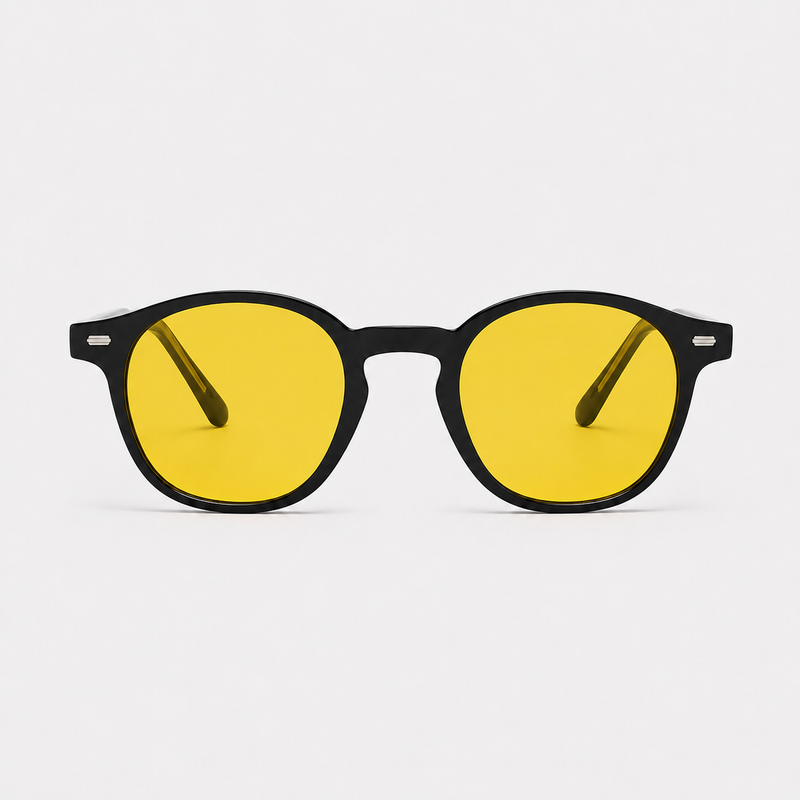
Pure, bright yellow. It trims the most energetic part of blue light and lets nearly all the light you need through, so you see clearly in front of a screen.
of the blue-violet
Between 415 and 455nm, the most energetic slice of the blue band.
of blue overall
Measured across the whole blue range, not only at its peak.
of visible light passes
Barely any dimming: you still see the world as it is.
Laboratory spectral transmission measurements on the same lenses we ship.
You don't just see light. Your body runs on it.
Cells in your retina have nothing to do with seeing. Their only job is to measure light and tell your brain what time it is. Here is what that sets in motion.
Cells that measure, not see
A special group of retinal cells takes no part in vision: it measures ambient light. They are most sensitive near 480nm, right in the blue. During the day that is exactly what you want: it is the signal that you are awake.
Peak sensitivity ≈ 480nmA 24-hour clock set by light
Your brain uses that signal to organize the day: when to be alert and when to wind down. That is why daylight is a good ally. The trouble starts when intense blue light follows you outside of daylight hours.
Key band ≈ 415 to 530nmHours of screens, eyes that notice
In front of a screen you blink less and focus up close for hours. Hence the dry eyes and heavy vision at the end of the day. Yellow trims the most energetic slice of blue without dimming the picture.
Light transmission 88.6%The alertness hormone
It follows a daily cycle: high in the morning, easing off toward night. Bright light at the right hour supports that rhythm. That is why yellow is the lens for daylight hours, saving the deeper filters for the end of the day.
Natural daily cycleWhat yellow cuts. And what it lets through.
Each dark band is light that never reaches your eye. Everything else passes. Figures come from laboratory spectral transmission measurements on our lenses.
Peak cut between 415 and 455nm. Plus ~84% of blue overall and UV400.
See it for yourself.
Move the slider to compare a bare screen with a screen seen through yellow. It is an illustration: the real tone depends on your display.
Three tints, three moments of the day.
How much blue is worth filtering changes with the hour. That is why there is no single lens: there is a ladder.
Dawn · AURORA
The gentlest filter. Cuts blue-violet without darkening your view.
Dusk · OCASO
The middle filter. Covers nearly all blue, including your body clock's peak.
Moon · LUNA
The deepest filter. Nearly all blue and part of green: candlelight.
Daylight. Without the excess.
Yellow is the gentlest step on the Ryva ladder, made for the hours when your body still needs bright light.
Not all blue-light glasses are alike.
The yellow lenses.
Prices and availability update automatically with the store.

The science, explained simply.
When do I wear the yellow lens?
During the day, on screen time. It is the gentlest filter: it reduces blue-violet without darkening your view, so you can wear it while you work, study or read.
Does it change the colors I see?
Barely noticeable. Of the three tints, it alters color perception the least.
Will it help me sleep better?
For nighttime the step made for it is red, the deepest one. Yellow is for daylight hours.
Can I drive or use it as sunglasses?
No. These are indoor lenses for screen use, and they are not certified as sunglasses or for driving.
Where do the percentages come from?
From laboratory reports with spectral transmission curves measured on samples of our lenses. We publish the figures as they come out, along with each tint's light transmission, so you can also see how much visible light it lets through.
Important note
Ryva lenses are a general-use optical product with a blue light filter. They are not a medical device: they do not diagnose, treat, cure or prevent any illness or sleep disorder, and they are not a substitute for consulting an eye care professional.
The percentages published on this page come from spectral transmission measurements taken in a laboratory on samples of our lenses, and describe the optical behavior of the filter, not a guaranteed clinical outcome. The information on light, circadian rhythm and hormones is offered for general education and reflects the broad state of research in the field; effects vary from person to person. If you have persistent visual discomfort or sleep problems, consult a health professional.
Our lenses are not certified as sunglasses or for use while driving.
Give your body the right signal.
Pick your pair and give every hour of the day the light it deserves.