


When the sun goes down, so should your light.
Pure, luminous orange. It widens the cut to cover nearly all blue light, including the zone where your body clock is most sensitive.
of blue filtered
Between 380 and 500nm, including your clock's peak-sensitivity zone.
the most sensitive point
Where your internal body clock responds most strongly to light.
of visible light passes
Half the light, in a warm tone you can notice: made for the evening.
Laboratory spectral transmission measurements on the same lenses we ship.
Afternoon light talks to your clock.
Your body can't tell a phone at 7pm from the midday sun: it reads the light it gets and reacts. Dusk is the moment to change the signal.
The signal your retina sends
Special retinal cells measure ambient light and tell your brain whether it is day or night. Their peak sensitivity is near 480nm, and orange cuts that zone almost entirely.
~97% cut between 380 and 500nmThe day is ending, does your clock know?
As evening falls, natural light turns warm and soft: the signal that the day is ending. A screen keeps a midday tone. With orange, the light reaching your eye looks more like a warm evening.
Evening transitionThe hormone that prepares sleep
Bright blue light in the hours before bed can delay its release. Filtering that band from dusk on helps the sleep signal arrive on time. It is the first step before the deeper night filter.
Can be delayed ~1.5h by bright screensThe alertness that should ease off
A daily-cycle hormone: high in the morning, easing toward night. Bright light at the wrong hour can interfere with that natural drop. Orange supports the descent.
Natural daily cycleWhat orange cuts. Nearly all the blue.
The dark zone runs from violet to blue-green, right where your body clock is most sensitive. Figures come from laboratory spectral transmission measurements on our lenses.
Cut between 380 and 500nm. Plus UV400.
See it for yourself.
Move the slider to compare a bare screen with a screen seen through orange. It is an illustration: the real tone depends on your display.
Three tints, three moments of the day.
How much blue is worth filtering changes with the hour. That is why there is no single lens: there is a ladder.
Dawn · AURORA
The gentlest filter. Cuts blue-violet without darkening your view.
Dusk · OCASO
The middle filter. Covers nearly all blue, including your body clock's peak.
Moon · LUNA
The deepest filter. Nearly all blue and part of green: candlelight.
The hour the day winds down.
Orange is the middle step: it covers nearly all blue as the sun starts to set and your body should read that the day is coming to an end.
Not all blue-light glasses are alike.
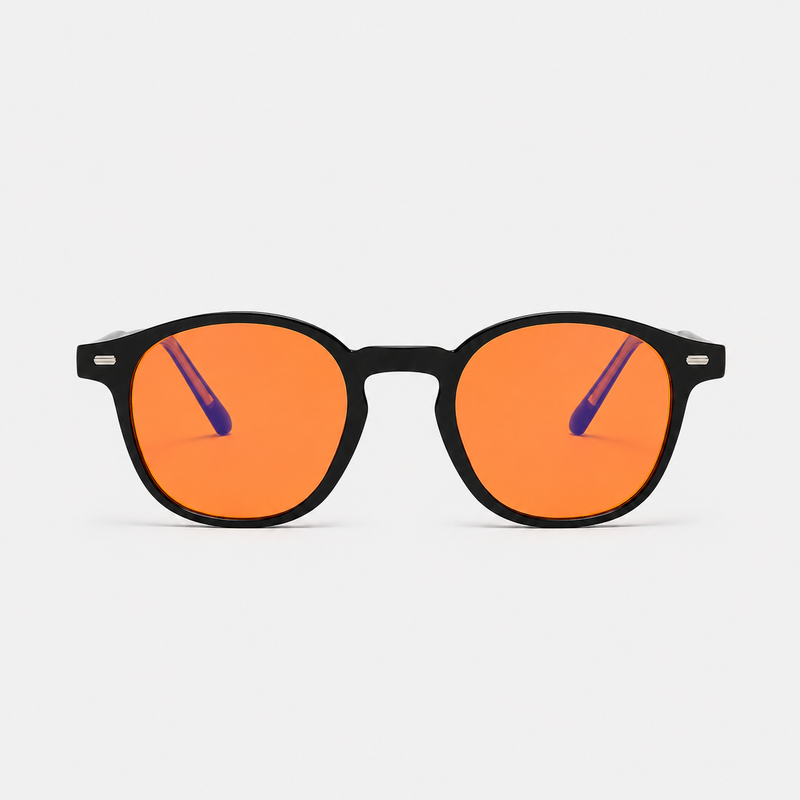
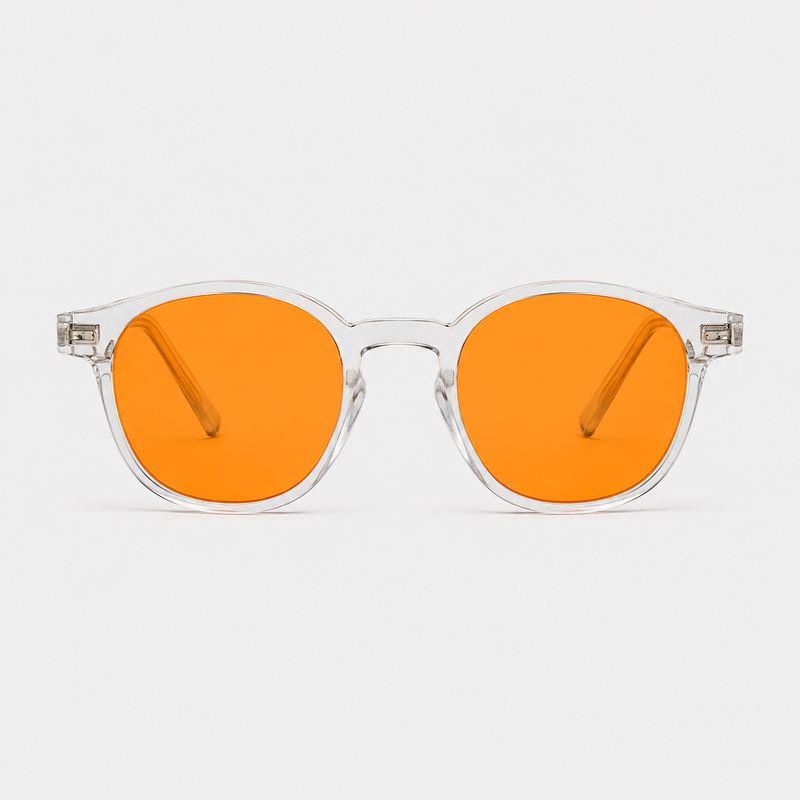
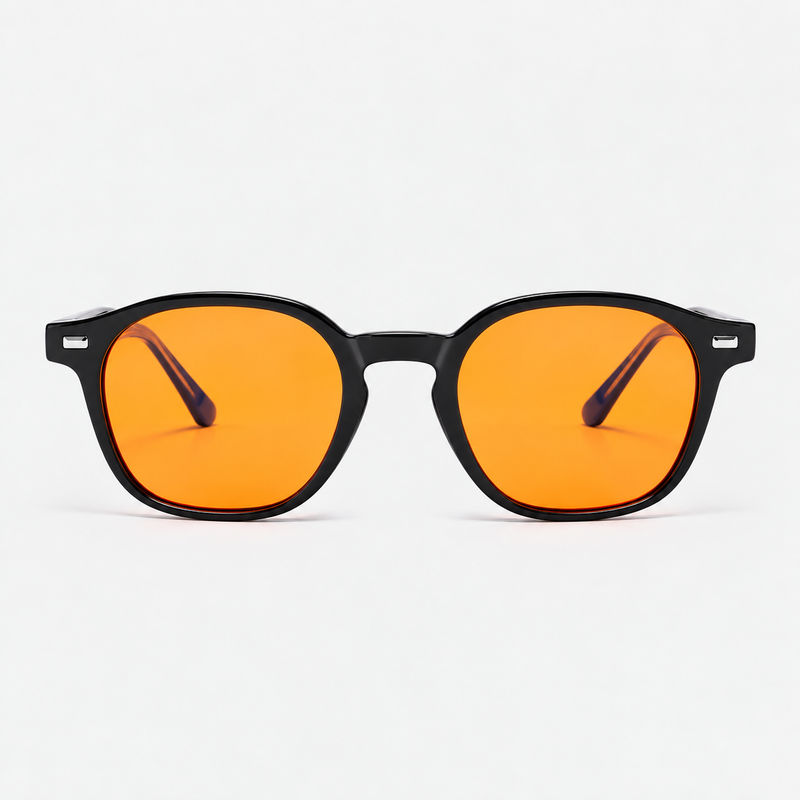
The orange lenses.
Prices and availability update automatically with the store.
The science, explained simply.
When do I wear the orange lens?
In the late afternoon and the transition hours, as the sun starts to set. It is the bridge between the gentle daytime filter and the deep night one.
Does it change the colors I see?
Yes, noticeably: it adds a warm cast. Your eyes adapt quickly.
Orange or red, which one?
Orange for the evening and the transition; red for the hours before bed, when you want the clearest night signal. Many people use both.
Can I drive or use it as sunglasses?
No. The shift in color perception makes it unsuitable for driving. These are indoor lenses and are not certified as sunglasses.
Where do the percentages come from?
From laboratory reports with spectral transmission curves measured on samples of our lenses. We publish the figures as they come out, along with each tint's light transmission, so you can also see how much visible light it lets through.
Important note
Ryva lenses are a general-use optical product with a blue light filter. They are not a medical device: they do not diagnose, treat, cure or prevent any illness or sleep disorder, and they are not a substitute for consulting an eye care professional.
The percentages published on this page come from spectral transmission measurements taken in a laboratory on samples of our lenses, and describe the optical behavior of the filter, not a guaranteed clinical outcome. The information on light, circadian rhythm and hormones is offered for general education and reflects the broad state of research in the field; effects vary from person to person. If you have persistent visual discomfort or sleep problems, consult a health professional.
Our lenses are not certified as sunglasses or for use while driving.
Give your body the right signal.
Pick your pair and give every hour of the day the light it deserves.